2026 Sleep Apnea Update: The End of the “Automatic 50%” Rating
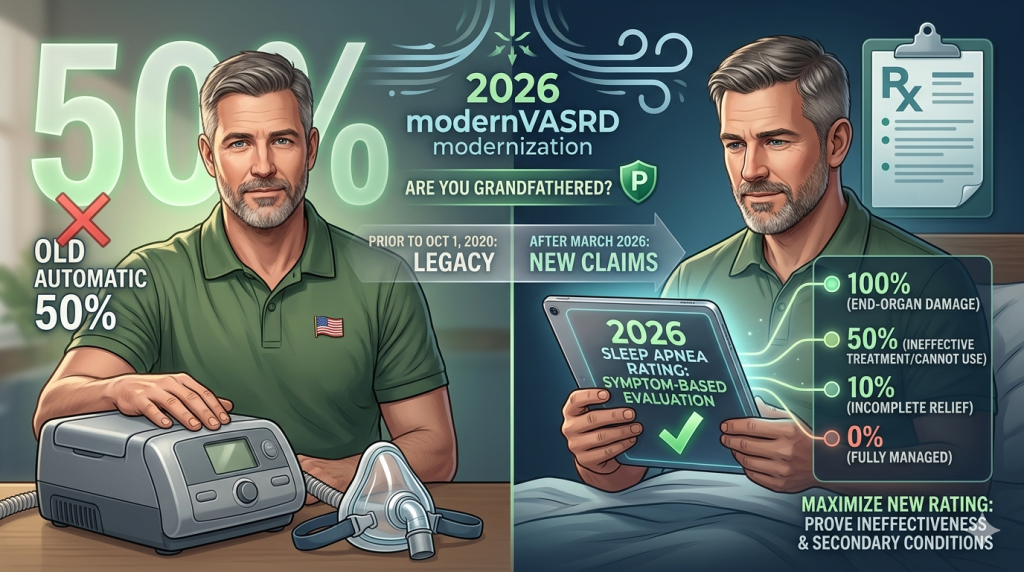
How the new symptom-based evaluation works and what “Grandfathering” means for your current benefits.
The Biggest Change in a Decade
For years, the VA’s rating for Sleep Apnea was relatively straightforward: if you were diagnosed via a sleep study and required a CPAP (or other breathing assistance device), you were almost always granted a 50% disability rating.
However, as part of the 2026 VASRD (VA Schedule for Rating Disabilities) modernization, the VA has moved away from rating based on the “device” and started rating based on the “symptom.” If you are filing a new claim this month, the rules have changed significantly.
1. The New 2026 Rating Scale
The 30% rating has been eliminated. The new structure evaluates how effective your treatment (CPAP, oral appliance, or surgery) actually is:
| Rating | 2026 Criteria |
| 100% | Sleep apnea with “end-organ damage” (like heart failure) caused by the condition. |
| 50% | Treatment is ineffective (confirmed by a sleep study) or the veteran cannot use the device due to a comorbid condition (like severe PTSD or a physical deformity). |
| 10% | You have “incomplete relief” despite using your CPAP or treatment. |
| 0% | Your sleep apnea is fully managed/asymptomatic with your treatment. |
2. Are You “Grandfathered” In?
If you already have a 50% rating for Sleep Apnea based on the old rules, do not panic.
- Protected Status: The VA cannot reduce your rating simply because the law changed. As long as your condition hasn’t improved and you don’t file for an increase, your 50% remains secure.
- The “Re-evaluation” Trap: Be careful—if you open a new claim for a secondary condition or ask for an increase, the VA may re-evaluate your sleep apnea under the new 2026 rules, which could result in a reduction if your CPAP is working perfectly.
3. Proving “Ineffective Treatment”
To get the 50% rating under the new 2026 rules, you must prove that the CPAP isn’t doing its job. The VA now looks for:
- Residual AHI: Your sleep study must show that even with the machine, you are still experiencing significant apnea events.
- Comorbidities: If your PTSD causes night terrors that make wearing a mask impossible, or if allergic rhinitis prevents you from breathing through the machine, you can still qualify for 50% because the treatment is “medically contraindicated.”
4. Sleep Apnea as a Secondary Condition
Because it is harder to get a high rating for Sleep Apnea on its own now, many veterans are focusing on Secondary Service Connection. In 2026, the most successful claims link Sleep Apnea to:
- Post-Traumatic Stress Disorder (PTSD): Due to the high correlation between sleep disturbances and mental health.
- Rhinitis/Sinusitis: Especially for PACT Act veterans who have airway obstruction.
- Weight Gain (Intermediate Step): If a service-connected knee or back injury prevented you from exercising, leading to obesity, which then caused Sleep Apnea.
March 2026 Action Plan
If you are struggling with sleep, follow these steps immediately:
- Get a New Sleep Study: Ensure it measures your “Residual AHI” (how you sleep while using the CPAP).
- Log Your Symptoms: Document “Daytime Hypersomnolence” (excessive sleepiness) and “Mental Fog,” even if you use your machine every night.
- Consult a VSO: Before filing, check if you fall under the “old” or “new” rules based on your Intent to File date.